Standing Correctly: A Field Guide to the British Queue and What Yours Is Saying About You
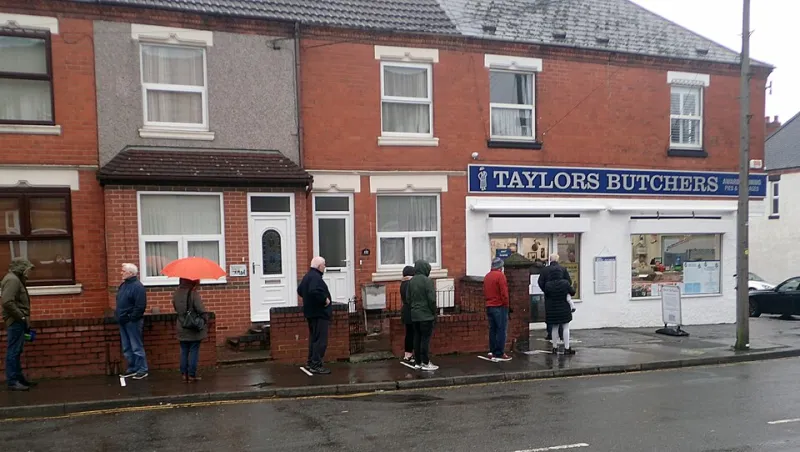
Photo: Gwydion M. Williams, CC BY 2.0, via Wikimedia Commons
We have spent a decade being told that personal branding happens online. The grid, the bio, the carefully angled headshot, the newsletter nobody unsubscribes from out of politeness. Meanwhile the most honest audit of your character takes place at 4:52pm on a Thursday, in a queue outside a Post Office, in front of nine strangers who will never see your website and would not care if they did.
This is the argument: the queue is the brand. Not the one you write. The one other people write about you afterwards, in that devastating British register of mild remark.
And it matters more in 2026, not less. As more of the country's services push people towards counters, kiosks and airport security lines, we are queueing more, in worse moods, with less patience and better phones. A nation that once prided itself on ordered waiting now does it under fluorescent light, with a bag, in a coat, after work. Character gets exposed.
Here, then, is the field guide. Deploy with care.
The Marker
Places a coat, a rucksack or, in the most audacious cases, a single shoe on the floor to denote that a space is held. The Marker believes they have invented a system. Everyone behind them believes they have invented cheek. In brand terms: confident positioning, weak customer experience.
The Narrator
Announces, unprompted, to no one in particular: "I've been here twenty minutes." The Narrator is not complaining. The Narrator is issuing a public record, in case history needs it later. They are, essentially, doing PR in real time — and everyone does the same small nod, which is the British equivalent of a retweet.
The Pre-Apologiser
Apologises for joining the queue. Apologises for having a question. Apologises, at the counter, for the existence of the transaction. This is the person whose website says "sorry, just a quick one" before they've offered you anything at all. Lovely. Invisible.
The Merger
Holding a place for four people who are "just coming". The queue is a queue; the Merger has quietly turned it into a small party, annexing territory in the process. We all know one. Several of us have been one, in a softer moment, at a gig in a venue with one bar and no chance.
The Auditor
Counts the people ahead. Counts the tills open. Counts the tills open against the people ahead. Produces a verdict — "they need another window" — with the quiet authority of a McKinsey contractor. Genuinely useful, deeply annoying, always right.
The Vanisher
Steps out to browse the greetings cards and rejoins, faintly sheepish. The queue's own version of a sabbatical. On social media they are the person who disappears for eight months and returns with "sorry, been quiet on here!!" Nobody minded. Nobody noticed. Welcome back.
The Steward
Here is the hero of this piece, and it is not a joke. The Steward is the one who, seeing someone with a stick, a buggy, a toddler, an obvious wince of pain, or just a face that has had enough, says: "you go ahead, I'm not in a rush." They hold the line for people who are struggling rather than for people who are loud. That is character, and everyone in earshot clocks it instantly.
Why any of this is branding
Because reputation in this country is still built by witness, not by declaration. We remain a culture that distrusts the hard sell and reads character off small behaviour: how you treat the person with the scanner, whether you say thanks and mean it, whether you fill the gap in a self-checkout queue or stand there broadcasting your grievance.
That is not naive. It is efficient. In a country where the loudest self-promotion still gets a raised eyebrow, being good at the boring bits is the most sustainable form of marketing you will ever do — it recruits other people to say the nice thing for you, which is the only endorsement that survives contact with a British audience.
There is also a less comfortable side. Queues expose how we read class. Who gets tutted at for a delay, who gets forgiven, whose "just coming" is tolerated and whose child is a nuisance — those calculations happen in nanoseconds and they are not neutral. If you want to know what your personal brand really is, watch which queue behaviour you forgive and which you resent. That is your values, written down, unedited.
Waiting well, practically
A short, unglamorous code:
- Hold one place, not a territory. Space for a friend is generous; space for a small delegation is empire-building.
- Do not narrate. The queue already knows.
- Have your card, your reference number and your story straight before you reach the counter. Preparation is the most underrated form of kindness.
- Notice who is struggling. Let them through. It costs you ninety seconds and buys you a reputation.
- Say thank you to the staff, out loud, by name if you can read the badge. In 2026 they have had a decade of being shouted at. Be the person they remember for the other reason.
The queue at the airport, the one at the venue, the one that snakes past the pharmacy — none of it is content. But it is all audience. Nine strangers, a bit bored, forming an opinion that will never reach you and will never quite leave you either.
We are, as a nation, still firmly of the view that you can tell a great deal about a person by the way they wait. Annoyingly, we are right. Stand accordingly.