Publishing the No: Why Britain's Reject Pile Is Now the Whole Personality
Photo: Alan Light, CC BY 2.0, via Wikimedia Commons
There's a genre of post doing the rounds on British design, illustration and writing feeds at the moment, and it is almost aggressively unglamorous. No carousel of finished work. No client logo wall, no tasteful beige border. Just a screenshot of a drafts folder — fourteen files, all called something like final_v3_ACTUAL, all lined up in a column like a row of failed auditionees — and a caption explaining why version nine got binned before anyone outside the flat ever saw it.
Six months ago this would have read as over-sharing. Now it reads as evidence.
The grid stopped being convincing
The finished thing used to be the flex. You posted the work, people admired the work, the work begat more work. Simple. But we've spent a decade being trained by brands to distrust the polished image, and the training has worked. A faultless feed now reads less like a portfolio and more like an advert. Which, of course, it is.
The reject, by contrast, is the one piece of content nobody is trying to sell you. It can't be optimised, it can't be A/B tested, and — crucially for a country that still flinches at the hard sell — it arrives without a price tag attached. It's the visual equivalent of someone saying "I've had a go at this before and it went badly", which is the most British opening line in existence.
What a no actually proves
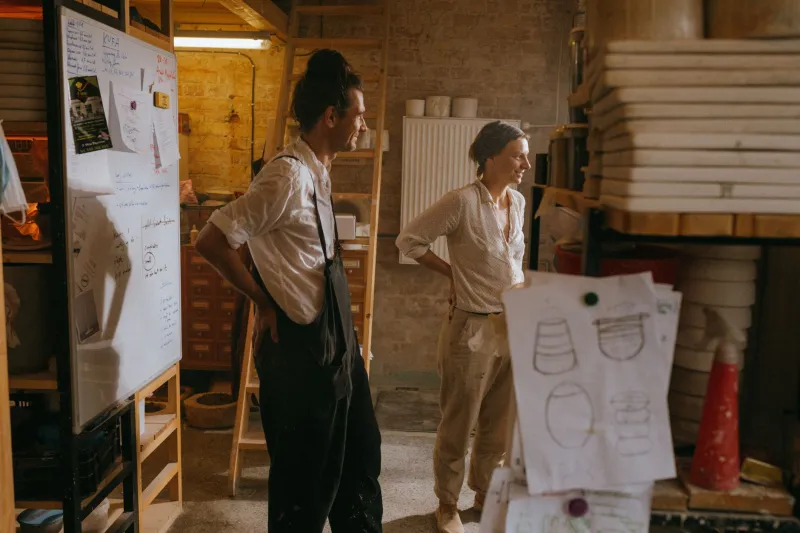
Here's the thing the "authenticity" think-pieces keep missing. Publishing your rejects isn't compelling because it's vulnerable. It's compelling because it's curatorial. Anyone can crowd a feed with output. Showing the work you chose not to release is the only way to demonstrate that you have taste — and taste is the bit of creative work that never shows up in the finished product.
A designer posting a rejected route is really saying: I can tell the difference between good and good enough, and I'm willing to eat the cost of that distinction. That's not a humblebrag. That's a portfolio in a different register.
Britain's ambition problem, solved by a screenshot
We are, as a nation, chronically allergic to saying what we want. The loudest person in any given British room is generally the one about to be quietly removed from the group chat. Announce that you're aiming for something big and you'd better have a self-deprecating joke strapped to it like a life jacket.
The reject pile threads that needle neatly. "I pitched this and it died" is a sentence that tells you three things at once: that I pitch, that I pitch at a scale worth noting, and that I'm still here. All the ambition of a humblebrag with none of the throat-clearing. It's the same trick as the self-deprecating Christmas ad — the one where a supermarket tells you it's about love, actually, and you cry into a mince pie — except here the sentiment is genuine.
The bit where it goes wrong
Nothing stays honest for long under capitalism. The reject post is already curdling into a subgenre of its own: the grief-porn carousel, the twelve-slide Story of a Failure that ends, with grim inevitability, in a link to a course. The tell is the moral. If your binned draft arrives with a lesson attached and a booking link underneath, you haven't shared a process — you've built a funnel with a sad photo on top.
There's also a class problem that nobody's naming yet. Posting your failures is a luxury good. A freelance illustrator on a three-month invoice cycle cannot afford to look fallible in public, because the algorithm is the shop window and the shop window has to sell. Celebrating the reject pile as an act of bravery is a bit rich coming from people whose reject pile didn't affect whether they made rent that month.
How to do it without becoming the worst person on LinkedIn
A short and unscientific guide, offered free of charge:
Be specific. "This page didn't work" is a mood. "This page didn't work because the client wanted it to say four things and I let them" is a piece of thinking. Give us the second one.
Redact the human. Client names, briefs, that one email from a marketing director in Slough — leave it in the drafts folder. The interesting thing is your judgement, not somebody else's rudeness.
Don't resolve it. The most magnetic version of this post is the one that ends in an open question rather than a revelation. British audiences can spot a redemption arc from three streets away and will treat it accordingly.
And post the ugly one. Not the almost-good one. Everyone can tell when the "reject" has been quietly reconsidered, buffed up and given a nicer typeface. The whole contract depends on the thing being genuinely dead.
The quiet arithmetic
What's actually happening here is a shift in what credibility looks like online. For ten years it was polish. Now it's proof of an inner life — evidence that there's a person doing the thinking, with a rubbish folder full of wrong turns, who has nonetheless managed to make one good decision in public.
That's a better personal brand than any grid. And it costs nothing but a screenshot.