Magnet Diplomacy: What Survives on the Family Fridge Door Still Runs Your Personal Brand
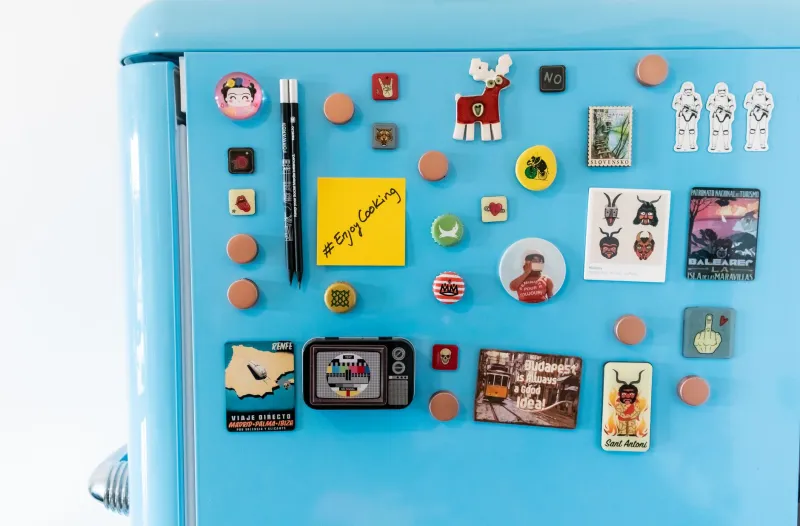
The train home in December is a strange kind of time machine. You arrive with a tote bag, a phone at 14%, and the vague sense that you are about to be reverted to a previous version of yourself. Then you walk into the kitchen, put the kettle on, and there it is: the fridge door. Britain’s most honest exhibition space. No ticket, no wall text, no curator’s statement — just a magnetic collage of who you were, who you nearly became, and which takeaway the household trusts after 9pm.
We talk a lot about personal branding now, as if it began with LinkedIn banners and a ring light. It didn’t. It began with a swimming certificate for 25 metres, slightly curled at the corner, held up by a magnet from Pizza Express. The fridge door was the first place your reputation was displayed to a captive audience. It was also the first place it was edited.
The Fridge Door Is a Feed, Not a Frame
A museum preserves things. A fridge door updates. That’s the crucial difference. The magnets move. The drawings migrate. A new grandchild’s masterpiece lands at eye level and your GCSE results — still impressive, technically — are quietly shifted towards the freezer. Nothing is deleted, exactly. It’s just algorithmically demoted by affection and kitchen traffic.
Mum is the original content moderator. She decides what gets pinned, what gets buried under the council recycling calendar, and what gets moved to the cupboard with the biscuit tin. There is no appeal process. There is only the slow, soft power of a woman who has decided that your Grade 3 piano certificate has had a good run.
And before you say it: yes, some fridges are bare. A completely clean door is its own statement — minimalist, rented-flat energy, or a household that has decided not to participate in the emotional economy of magnets. But even the absence is curated. The fridge door is never neutral. It is the domestic equivalent of a pinned post.
What Gets Pinned, What Gets Demoted
The taxonomy is fairly consistent across Britain. At the top of the hierarchy: anything produced by a grandchild. A biro squiggle that vaguely resembles a dog will outrank your degree, your promotion, and your first proper newspaper byline. This is not personal. It is simply engagement. The grandchild’s drawing gets more footfall.
Next: certificates that prove survival or effort. Swimming, piano, karate, a cycling proficiency badge from an era when the road felt wider. These are not necessarily your best achievements. They are the ones that fit a magnet. A fridge door is a small-format medium. It rewards the tangible, the laminated, the slightly tragic.
Then there are the aspirational magnets: Pizza Express, Center Parcs, a National Trust property you visited once in 2019, a local garage that fixed the boiler. These are not adverts. They are tiny civic announcements: we go out, we trust this plumber, we have a life beyond the kitchen. A fridge door covered in takeaway menus is a household that has made peace with Wednesday.
And then there is the demoted layer — the cupboard archive. Your first driving licence photo, the one where you look like a startled Victorian ghost. A school report with the phrase ‘could apply himself more’ still legible. The programme from a school play where you were Third Shepherd. These items are not failures. They are simply no longer current. The cupboard is a shadowban, not a cancellation.
The Politics of the Door
The fridge door is also a quiet lesson in who gets displayed. In many homes, it is still Mum who curates: who prints the photos, who buys the magnets, who decides that the new baby announcement goes next to the electricity meter reading. That is unpaid emotional labour dressed up as decoration. It is also a kind of soft power. The person who controls the door controls the story.
There is a class dimension, too, though not the one you might expect. The fridge door is less about money than about evidence of administration. A house that can produce a swimming certificate on demand is a house that files things. A house with a dentist appointment card under a magnet is a house that is holding it together. The fridge door is a small, magnetic proof of a life being managed.
And there is the deeply British embarrassment of seeing your own childhood on display next to a takeaway menu. You want to be cool about it. You make a joke about the blurry school photo. But underneath, there is a small, ridiculous pleasure: you are still on the door. You have not been moved to the cupboard. You are, in the language of the internet, still pinned.
Your First Profile Picture Was a Fridge Magnet
Here’s the uncomfortable bit: the fridge door taught us how to present ourselves long before we had a bio to write. We learned that pride is selective, that achievements need a magnet, and that the audience you care about is not the biggest one — it’s the one in the kitchen.
That logic hasn’t gone away. It’s just moved online. We still pin things. We still demote things. We still hope a certain person will see the version of us that looks like we’re doing well. The difference is that the fridge door audience was captive and loving. The internet audience is infinite and indifferent. We have taken a domestic ritual of affection and turned it into a metrics problem. No wonder we’re tired.
The fridge door also had a built-in limit. It was small. It couldn’t show everything. It forced a kind of editorial restraint. Your online profile has no such limit, which is why it can feel like a cupboard that never closes. The magnetic archive was kinder. It said: this is enough for now. We’ll rotate in the spring.
A Field Guide to Reading Yours
So when you go home this December, read the door before you straighten it. A certificate at eye level means you are current. A photo under a takeaway menu means you are loved but not urgent. A childhood drawing fading behind a Center Parcs magnet means you have been archived, not deleted. A bare door means something else entirely — ask, gently, and don’t assume.
And if you find your own GCSE results at the back, held by a magnet from a garage that closed in 2014, don’t take it personally. You are not a failure. You are part of the permanent collection. The museum of you is not in a gallery. It’s in a kitchen, next to the kettle, and it is still open.
The Take-Home
Your personal brand began on a fridge door, and it was never really about achievement. It was about belonging. The magnet was the like button. The cupboard was the algorithm. The grandchild’s drawing was viral content. And your mum, whether she’d call herself one or not, was the editor.
So this December, before you post anything — a photo, a life update, a quiet flex — ask yourself the fridge-door question: would this survive the kitchen? Would it be pinned, demoted, or quietly moved to the cupboard with the biscuit tin? The answer is usually more useful than a follower count. And if you’re lucky, there’s still a cup of tea waiting, and a magnet with your name on it.